
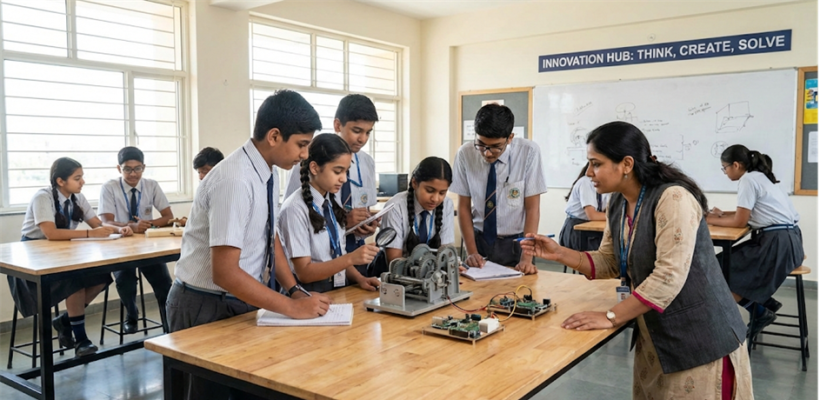
Introduction: Why “Using Technology” Is No Longer Enough
Today’s students can use smartphones, apps, and robots with ease.
But ask them how these systems work, why they behave the way they do, or how they could be improved, and the gap becomes clear.
This is the silent crisis in modern education.
Most school programs focus on doing—coding, assembling, operating.
Very few focus on understanding.
That’s where GEAR comes in.
The GEAR Experiential Learning Program is designed to help students move beyond surface-level interaction with technology and develop the ability to observe, question, analyze, and improve real-world systems. It is not a robotics class, not a competition module, and not a kit-based activity.
GEAR is a thinking-first learning ecosystem for students from Grades 1 to 12.
What Is GEAR?
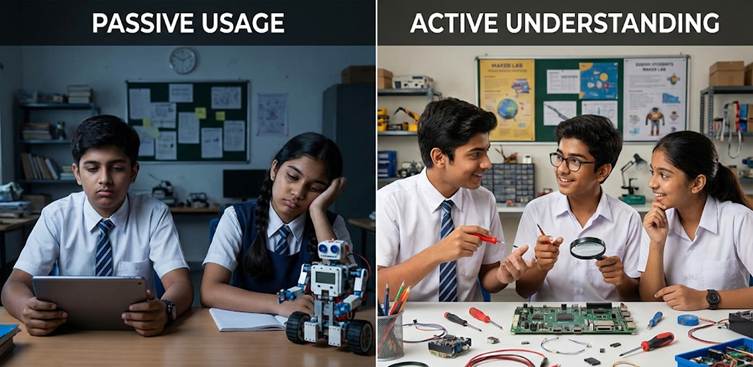
GEAR: Experiential Learning & Innovation Program
GEAR is a structured, school-integrated experiential learning program that enables students to:
- Explore real-world objects, products, and systems
- Understand how mechanisms, circuits, sensors, and data flows work
- Study design logic and engineering decisions
- Build, test, and improve solutions
- Reflect on real-world impact and learning outcomes
In simple terms, GEAR teaches students how technology is designed, not just how it is used.
Unlike traditional STEM programs, GEAR does not end learning when a model works. Learning begins there.
Why GEAR Was Created: The Problem with Traditional Programs
Most technology programs in schools suffer from three major limitations:
1. Tool-First Learning
Students are taught which tool to use, not why it works.
2. Step-Following Over Thinking
Activities are often procedural, leaving little room for questioning or reasoning.
3. Outcome-Focused, Not Understanding-Focused
Once a robot moves or a circuit lights up, learning stops.
GEAR challenges all three.
It shifts the focus from:
“What can I build?”
to
“How does this system work, and how can it be made better?”
How the GEAR Learning Framework Works
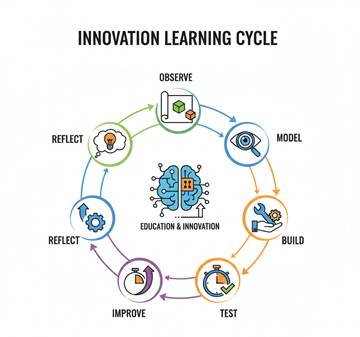
The GEAR Learning Cycle
GEAR follows a structured, repeatable learning framework:
Observe → Model → Build → Test → Improve → Reflect
This cycle ensures that:
- Curiosity comes before construction
- Understanding comes before automation
- Reflection becomes part of learning
Technology becomes a medium, not the goal.
Core Learning Pillars of GEAR
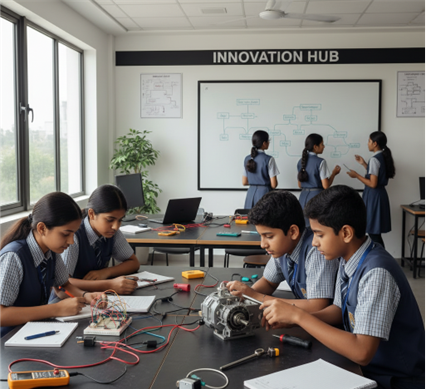
1. System Thinking & Engineering Understanding
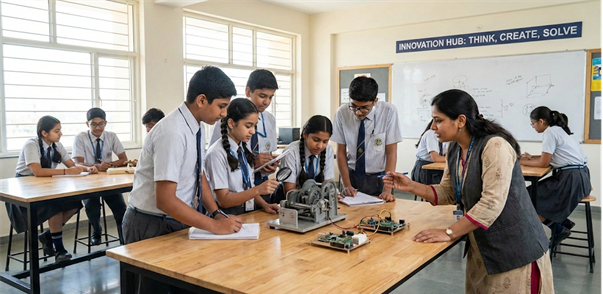
Students explore real-world systems by:
- Studying gears, motors, sensors, circuits, and mechanisms
- Creating exploded views and system diagrams
- Explaining working principles in their own words
- Improving performance through redesign
This builds logical reasoning, cause-effect understanding, and engineering intuition.
2. Robotics & Automation (With Purpose)
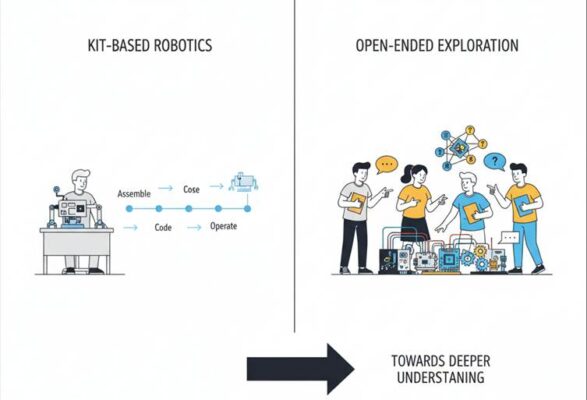
Instead of kit-based robotics, students learn:
- Motion systems and mechanical logic
- Sensors, actuators, and control flow
- Real-world automation use cases
Robotics becomes a means to understand systems, not a competition outcome.
3. AI Thinking & Logical Reasoning
GEAR introduces AI concepts in an age-appropriate, concept-first manner, including:
- Rule-based decision making
- Logical problem modeling
- Human vs machine thinking
- Foundations of artificial intelligence
Students learn how machines think, not just how to code them.
4. Data Awareness & System-Based Data Thinking
Students develop early data literacy through:
- Observation and data collection
- Understanding data logic and interpretation
- Connecting data to real-world systems
This prepares them for AI, analytics, and future technologies.
5. Innovation & Design Thinking
Students learn to:
- Identify real problems
- Generate ideas
- Prototype and test solutions
- Iterate based on feedback
Innovation becomes structured, intentional, and real-world relevant.
Grade-Wise Learning Progression (Grades 1–12)
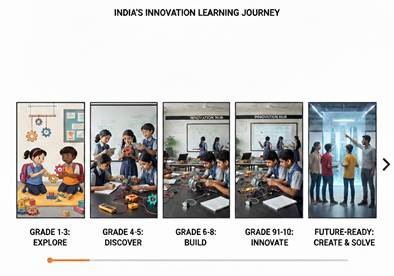
GEAR is not a one-size-fits-all program. Learning deepens with age.
Grades 1–3
- Exploring everyday objects
- Understanding simple mechanisms
- Building curiosity and observation skills
Grades 4–5
- Understanding how machines and products work
- Introduction to systems and logic
Grades 6–8
- System analysis and automation
- Logical reasoning and functional understanding
Grades 9–10
- AI logic and data-driven thinking
- Product improvement and redesign
Grades 11–12
- Engineering thinking
- Exposure to emerging technologies including AI, data systems, and advanced concepts
What Students Gain from GEAR
Students develop:
- Strong curiosity and questioning skills
- System-level and logical thinking
- Real-world problem-solving ability
- Creativity and innovation mindset
- AI and data awareness
- Confidence to understand any technology, not fear it
These are lifelong skills, not syllabus-bound outcomes.
Academic Alignment & Credibility
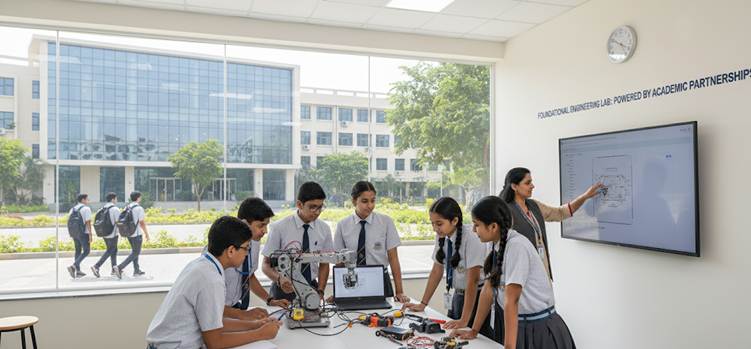
Inspired by IIT Madras Pedagogy
GEAR’s learning framework is academically aligned with LEAP (Learn Engineering by Activity with Products), an initiative of the IIT Madras Incubation Cell.
This ensures:
- Conceptual depth
- Activity-based engineering learning
- Academic rigor without rote learning
NEP 2020 & CBSE Alignment
GEAR supports:
- NEP 2020 experiential learning principles
- CBSE Composite Skill Labs
- SkillBodh and future-ready curriculum goals
It integrates into school timetables—not as an extra club, but as a core learning program.
Why Schools Choose GEAR
Schools prefer GEAR because it is:
✔ Curriculum-integrated
✔ Thinking-first, not tool-first
✔ Scalable from Grades 1–12
✔ Not dependent on a single kit or vendor
✔ Focused on understanding, not competition
Pros and Cons of the GEAR Approach
Pros
- Deep conceptual understanding
- Long-term skill development
- Aligns with future careers
- Encourages questioning and innovation
Cons
- Requires trained facilitators
- Not suitable for shortcut, outcome-only expectations
- Learning depth takes time (by design)
Common Mistakes Schools Make (And How GEAR Avoids Them)
Mistake 1: Treating STEM as extracurricular
→ GEAR integrates with curriculum
Mistake 2: Overemphasis on coding early
→ GEAR builds understanding before coding
Mistake 3: Competition-driven learning
→ GEAR focuses on thinking, not trophies
Future Trends in School Education That GEAR Addresses
- Shift from memorization to understanding
- Demand for AI and data literacy
- Need for interdisciplinary thinking
- Emphasis on real-world problem solving
GEAR prepares students not just for exams, but for life and careers.
FAQs: People Also Ask
What is the GEAR Experiential Learning Program?
GEAR is a school-integrated experiential learning program that helps students understand how real-world systems and technologies work through observation, analysis, and innovation.
Is GEAR a robotics program?
No. Robotics is only one medium. GEAR focuses on system thinking, logic, and understanding technology.
Is GEAR aligned with NEP 2020?
Yes. GEAR strongly aligns with NEP 2020’s experiential and skill-based learning framework.
Which grades can implement GEAR?
GEAR is designed for Grades 1–12 with structured progression.
How is GEAR different from STEM kits?
GEAR is not kit-dependent. It emphasizes understanding systems, not assembling predefined models.
Conclusion: GEAR Builds Thinkers, Not Just Technologists
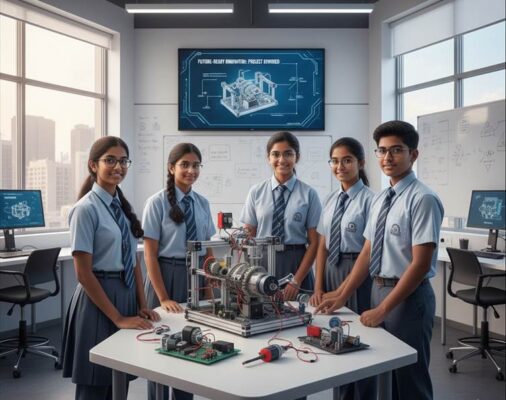
In a world where technology evolves faster than syllabi, understanding beats memorization.
The GEAR Experiential Learning Program equips students with the mindset to:
- Question systems
- Understand technology
- Innovate responsibly
- Adapt to any future
For schools serious about future-ready education, GEAR is not an option—it’s a necessity.
Actionable Takeaway for Schools If your goal is to prepare students for the future—not just exams—
GEAR is the foundation your learning ecosystem needs